
 Roland Jakob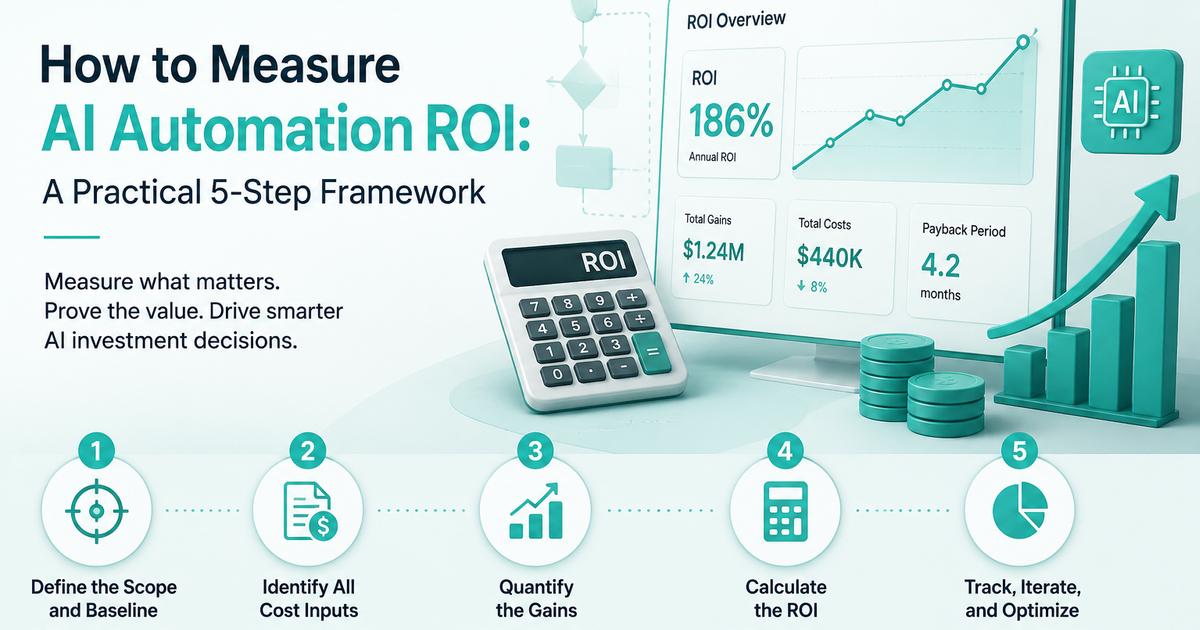
TL;DR - Quick Answer
Measure AI automation ROI by baselining the process, counting total costs, quantifying gains, and reviewing payback at 30, 60, and 90 days.
- 1. Baseline first. You can't measure ROI without knowing what the process costs today.
- 2. Count all costs: licensing, implementation, ongoing ops, and change management.
- 3. Quantify gains specifically: time savings, error reduction, throughput, and revenue enablement.
- 4. Use the formula: (Gains − Costs) / Costs × 100, with a payback period alongside.
- 5. Review at 30/60/90 days and quarterly thereafter. Stable-state measurement starts at 90 days.
- 6. Track the 5 KPIs: Total ROI, cost per task, time-to-value, automation rate, error rate reduction.
On this page
To measure AI automation ROI, start by capturing the baseline cost and cycle time of the process, then track the savings, throughput changes, and quality improvements that show up after automation goes live. A usable AI automation ROI framework must include implementation cost, ongoing operating cost, payback period, and a review cadence so you can compare real gains against total investment.
This guide is written for operators who need to justify AI automation with defensible numbers rather than vendor promises. Use it to build a business case, pressure-test assumptions with finance, and decide whether an automation is actually improving operations or just creating activity that looks modern.
Why AI Automation ROI Is Hard to Measure
Before you build the measurement model, it helps to understand why this is harder than measuring a software licence or a headcount reduction.
Benefits are dispersed and indirect. A single AI-automated workflow might save two hours per week for an ops analyst, reduce error rates in a downstream system, and free up a manager to focus on higher-value work. Each benefit is real, but none of them shows up in a single budget line.
There's a time-lag problem. AI automation benefits tend to compound. The first 30 days after go-live are often the slowest. Teams are still learning, edge cases are being resolved, and adoption isn't uniform. Measuring ROI too early produces misleading numbers that can kill a project prematurely.
Soft ROI is real but hard to quantify. Faster cycle times, reduced employee frustration, lower risk of compliance errors: these have genuine business value, but they resist clean dollar figures. Many ROI models ignore them entirely, which systematically understates the return.
Sunk costs distort the picture. Once implementation costs have been paid, there's a temptation to strip them out of ongoing ROI calculations. This makes the numbers look better but obscures the true cost of ownership over time.
A solid measurement framework accounts for all of this. Here's how to build one.
The 5-Step Measurement Framework
Step 1: Define the Scope and Baseline
ROI measurement starts before the AI goes live. You need a clear baseline: what does this process cost today, and what does it produce?
For each process you're automating, document:
- Cycle time: How long does the process take end-to-end, and per task?
- Volume: How many times does it run per day/week/month?
- Headcount cost: How many FTEs touch this process, and what portion of their time?
- Error rate: What percentage of outputs require rework or correction?
- Current tooling costs: What does the status quo cost to run, including software, oversight, and escalation handling?
This baseline becomes your denominator. Without it, you're measuring from nothing.
_Note: If you haven't mapped the underlying workflow yet, do that first. Automating an unmapped process is one of the most common ways AI projects underdeliver. Our guide on why most businesses need workflow clarity before they need more AI tools walks through the framework for getting that right._
Step 2: Identify All Cost Inputs
ROI calculations fail when they only count the obvious costs. A complete cost picture includes:
- Licensing and platform fees: monthly or annual cost of the AI tool(s)
- Implementation costs: internal engineering time, vendor professional services, integration work
- Training and change management: time spent upskilling staff, documentation, internal comms
- Ongoing operations: model monitoring, prompt maintenance, edge-case handling, QA
- Opportunity cost: the value of internal time diverted to the project during implementation
Many organisations calculate a rough implementation cost and call it done. The ongoing ops cost is frequently underestimated and will inflate your true cost of ownership if left out.
Step 3: Quantify the Gains
This is where most frameworks get vague. Get specific. For each automated process, estimate:
- Time savings: (Old cycle time − New cycle time) × Volume × Loaded labour rate
- Error reduction savings: (Old error rate − New error rate) × Volume × Cost per error (rework time + escalation cost)
- Throughput increase: If volume has grown without adding headcount, calculate the implied labour cost avoided
- Revenue enablement: If the automation enables faster customer responses, reduced churn, or higher capacity, estimate the revenue impact conservatively
Where you can't put a hard number on a benefit, document it as a qualitative gain with a directional estimate. Don't drop it from the model. Note it separately as additional value not captured in the headline figure.
Step 4: Calculate the ROI
| The core formula: | ROI = (Total Gains − Total Costs) / Total Costs × 100 |
|---|---|
| Calculate this on an annualised basis. Also calculate: | |
| Payback period = Total Costs / Monthly Net Gain | |
| This tells you how many months until the investment breaks even, which is a figure most CFOs and boards want to see alongside the headline ROI percentage. | |
| A few practical notes: |
- Use loaded labour rates (salary + benefits + overhead), not just salary
- Discount ongoing costs over time if you're modelling a multi-year ROI
- Flag illustrative figures clearly. If you've estimated error cost using an industry benchmark rather than internal data, say so
Step 5: Set a Review Cadence
ROI measurement isn't a one-time exercise. Build a review cadence into the project plan:
- 30 days post-launch: Check adoption rate and catch early errors. Don't draw ROI conclusions yet. It's too early.
- 60 days: First real read on time savings and error reduction. Compare to baseline.
- 90 days: Stable-state measurement. Use this as your primary ROI data point.
- Quarterly thereafter: Track whether gains are holding, compounding, or degrading. AI automations can drift if not maintained.
Document each review cycle. If ROI is below expectations, you want a paper trail that helps you diagnose why, not a gap you discover twelve months later.
The 5 KPIs That Actually Matter
There are dozens of metrics you could track. These five give you the clearest signal on whether your AI automation investment is working.
1. Total ROI of AI Investment The headline figure. (Total annualised gains − Total annualised costs) / Total costs × 100. Review quarterly.
2. Cost per AI-Assisted Task Total cost of the automation (licensing + ops) divided by the number of tasks processed. Tracks efficiency over time and should decrease as volume scales.
3. Time-to-Value The number of days from go-live to first measurable gain. Shorter time-to-value indicates good implementation quality and fast adoption. Benchmark: aim for measurable gains within 30–45 days for a well-scoped automation.
4. Automation Rate The percentage of eligible tasks that are fully handled by the AI without human intervention. A low rate suggests either a scoping problem (the wrong tasks were automated) or an adoption/confidence problem.
5. Error Rate Reduction (Pre-automation error rate − Post-automation error rate) / Pre-automation error rate × 100. One of the most undervalued ROI drivers. Error costs compound across rework, escalation, and customer impact.
A Worked Example: Invoice Processing Automation
Here's how the framework applies to a specific scenario. (Numbers are illustrative; flag these as such in any real business case.)
Baseline:
- 500 invoices processed per month
- Average processing time: 12 minutes per invoice
- 3 FTEs at a loaded rate of £45/hour
- Error rate: 8% (requiring ~20 min rework each)
- Monthly processing cost: (500 × 12 min / 60) × £45 = £4,500
- Monthly error rework cost: (500 × 0.08 × 20 min / 60) × £45 = £300
- Total baseline cost: £4,800/month
After automation:
- Average processing time reduced to 3 minutes (human review of AI output)
- Error rate reduced to 1.5%
- Monthly processing cost: (500 × 3 min / 60) × £45 = £1,125
- Monthly error cost: (500 × 0.015 × 20 min / 60) × £45 = £56
- AI platform cost: £600/month
- Total new cost: £1,781/month
Monthly gain: £4,800 − £1,781 = £3,019 Annualised gain: £36,228
Implementation cost (one-time): £18,000 Payback period: 18,000 / 3,019 = ~6 months Year-1 ROI: (£36,228 − £18,000 − £7,200 annual platform) / (£18,000 + £7,200) × 100 = ~44%
This is a conservative model. It doesn't include the value of the two FTEs who can now focus on higher-value work, or the downstream benefit of fewer invoice errors reaching the payment run.
Common Pitfalls That Distort AI ROI
Only counting hard costs, ignoring opportunity cost. The internal time spent scoping, testing, and managing the implementation is real cost. If you don't include it, your ROI looks artificially strong, and your next project will be scoped the same way.
Measuring too early. Thirty-day numbers are almost always weaker than ninety-day numbers. Teams are still adapting, exceptions haven't been resolved, and adoption isn't at steady state. If you measure too early and the numbers are poor, you may kill a project that was on track.
Cherry-picking metrics. It's tempting to report the KPIs that look good and exclude the ones that don't. This erodes trust with finance and leadership. Report the full picture. If error rates are down but processing time savings are lower than expected, say that, and explain why.
Ignoring change management costs. Retraining staff, updating SOPs, managing resistance to new workflows: this has real cost. Projects that exclude it consistently underestimate total cost of ownership.
Confusing activity with value. High automation rates and large task volumes are proxy metrics, not value metrics. The question is always: what is the financial impact of those tasks being automated? Stay anchored to that.
Conclusion
Measuring AI automation ROI isn't complicated in principle, but it requires discipline about baselines, cost inputs, and cadence. The five-step framework here gives you the structure to build a business case that will hold up to scrutiny: define your scope and baseline, capture all costs, quantify gains carefully, calculate ROI with a payback period, and review on a structured cadence.
The organisations that do this well aren't just better at reporting. They're better at spotting where automation is underperforming and fixing it before it becomes a write-off.
If you're building out a broader operational AI programme and want to see how ROI measurement fits into the full implementation lifecycle, our step-by-step guide to building a framework for operational AI automation covers the full picture, from process selection and governance through to ongoing measurement.
FAQ
What is a good ROI for AI automation?
There's no universal benchmark, but most well-scoped AI automation projects targeting repetitive, high-volume processes achieve year-one ROI in the range of 30–150%. Simple process automations (data entry, document routing) tend to payback faster; complex decision-support tools take longer. What matters more than the percentage is whether you've captured all costs and measured at stable state (90+ days post-launch).
How long does it take to see ROI from AI automation?
For a well-scoped automation, expect a meaningful signal at 60 days and a reliable read at 90 days. Payback period on implementation costs typically falls between 4–12 months depending on process volume and complexity. Measuring before 60 days almost always understates returns.
What's the difference between ROI and payback period?
ROI is the percentage return on your total investment over a given period (usually annualised). Payback period is the number of months until net gains cover upfront costs. Both matter for a complete business case. ROI tells you the value of the investment, payback period tells you when you'll stop being in the red.
What costs should I include when calculating AI automation ROI?
Platform licensing, implementation (internal engineering time + vendor services), training and change management, and ongoing operations (monitoring, maintenance, edge-case handling). Many organisations forget ongoing ops costs and opportunity cost of internal time, both will inflate your true cost of ownership if excluded.
Can I measure ROI for AI automation that improves quality rather than speed?
Yes. Translate quality improvements into financial terms: error rate reduction × volume × cost per error (rework time + escalation cost). If the downstream impact is customer-facing (fewer complaints, lower churn), apply a conservative revenue impact estimate. Document any gains you can't fully quantify as separate qualitative benefits. Don't drop them from the business case entirely.
Why do so many AI automation projects fail to prove ROI?
Usually one of three reasons: no baseline was captured before go-live, ROI was measured too early (before stable state), or only hard cost savings were counted while error reduction, throughput gains, and change management costs were ignored. The result is a model that's either incomplete or measured at the wrong moment.
How often should I review AI automation ROI after launch?
30 days (adoption and error check only), 60 days (first directional read), 90 days (stable-state primary measurement), then quarterly. Don't draw conclusions from 30-day numbers they're consistently weaker than 90-day figures and can prematurely kill a healthy project.
More from the blog

Why AI Strategy Fails at Execution (And How to Bridge the Gap)
Most AI strategies fail at execution, not strategy. Learn how to identify execution gaps and bridge them with practical frameworks.

Why AI Won't Fix Bad Workflows (And What To Do About It)
AI doesn't fix broken workflows. It automates them. Before you invest in AI automation, learn how to assess your processes for clarity, ownership, and exception rates so you're not paying to scale your problems.

8 Operational AI Use Cases That Actually Work
Explore operational AI use cases that improve forecasting, exception handling, reporting, routing, and other core business processes with measurable impact.